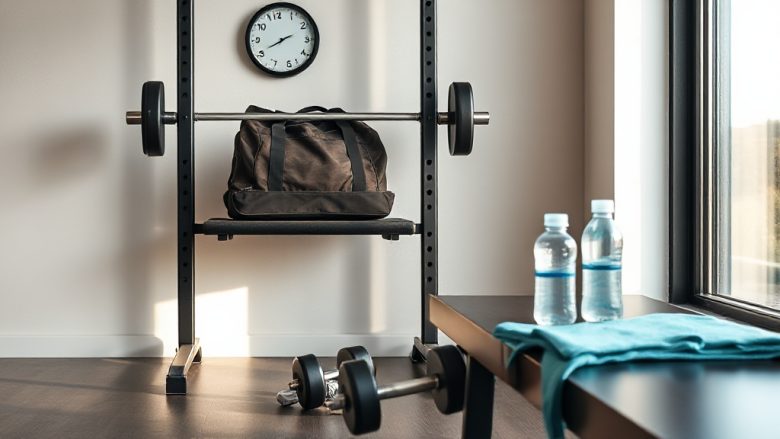
You do not need two hours in a gym. That idea has talked more people out of training than any injury or lack of motivation ever has. If you have thirty minutes, three times a week, you can build real strength, keep your heart working properly and feel noticeably better in your clothes. What you cannot do is wander between machines for an hour and call it a session. Short training rewards structure and punishes dithering, so the routines below are built to be started the moment you walk in and finished before your parking ticket expires.
These gym routines for busy people assume nothing fancy. A rack or a bench, a few dumbbells, a cable stack and twenty-five to thirty-five minutes of actual work. Warm-up is included in the timing because pretending it is free is how sessions quietly become fifty minutes. Pick one routine, run it for four to six weeks, then decide whether it earned its place.
Routine one: the three-lift strength session
This is the one to choose if your main goal is getting stronger and you can only train three days a week. It leans on three big compound movements per session, done with enough rest to keep the weight honest. Rest is where people lose time, so use a timer rather than your phone’s notification feed.
Warm-up: five minutes. Two minutes of easy cardio, then two or three progressively heavier sets of the first exercise with low reps. That is it. You are warm, not tired.
Main work. Pick one squat pattern, one push and one pull. A typical day looks like this. Squat or goblet squat: four sets of five reps, resting two minutes between sets. Bench press or dumbbell press: four sets of six reps, resting ninety seconds. Bent-over row or cable row: four sets of eight reps, resting ninety seconds. Load the bar so the last rep of each set is genuinely hard but not a grind that takes five seconds to complete. If you finish all sets and could have done three more reps, add weight next time.
Finish with one accessory for whatever felt weakest, two sets of ten to twelve reps, sixty seconds rest. Triceps if your press stalled, hamstrings if your squat felt shaky, upper back if your posture is a desk casualty. Total time: thirty to thirty-five minutes once you stop checking your phone between sets.
Run this Monday, Wednesday and Friday, or any three non-consecutive days that survive your actual week. Shift workers should anchor it to the days after a rest day rather than to named weekdays, because a rotating rota will break a Monday habit within a month.
Routine two: the thirty-minute full-body circuit
This suits anyone whose week is unpredictable, who trains at home with minimal kit, or who wants to feel worked rather than technically precise. It is a circuit, which means you move from one exercise to the next with short rests and repeat the whole thing three times. The trade-off is real: you will not add much weight to a barbell doing this, but you will get a lot of quality work done in a very small window.
Warm-up: four minutes of skipping, brisk walking or cycling, then a set of ten bodyweight squats and ten arm circles. Do not skip this. Circuits feel easy for the first round and brutal by the third, and cold joints do not forgive.
Round structure. Six exercises, forty seconds of work, twenty seconds of rest, then ninety seconds rest between rounds. Goblet squat. Push-up or dumbbell floor press. Dumbbell Romanian deadlift. One-arm dumbbell row, switching sides halfway. Plank or dead bug. Standing overhead press with dumbbells. Three rounds takes roughly twenty-two minutes including rest, leaving you time for two minutes of stretching or a slow walk to cool down.
If you are new to training, start with two rounds and build up over three weeks. If you are fit and bored, add a fourth round rather than adding weight, because form collapses fast when you are breathing hard. Keep a note of the dumbbell you used each week. Progressive overload in a circuit means slightly more weight or slightly fewer seconds of rest, not just sweating more.
This routine is the most forgiving of the three. Miss a day and you can slot it in the next morning without upsetting the rest of the week, which matters more than most training plans admit.
Routine three: the two-exercise emergency session
Some weeks you get one window, not three. This is the routine for those weeks, and it is deliberately short so that the choice is between twenty minutes of training and nothing, rather than between a full session and nothing. It is not a long-term plan. It is a way to keep the habit alive when your calendar has other ideas.
Pick one lower-body movement and one upper-body movement that you can load reasonably. Trap bar deadlift and dumbbell bench press is a good pairing. So is front squat and pull-up, or leg press and seated row. Warm-up for three minutes, then work up to three heavy sets of five on the first exercise with two minutes rest, and three sets of eight on the second with ninety seconds rest. That is fifteen to twenty minutes of real work.
If you have five minutes left, add a carry. Pick up the heaviest dumbbells you can hold and walk for thirty seconds, rest thirty, repeat three times. It hits your grip, your trunk and your lungs at once, and it is the closest thing to a full session you can get in five minutes.
The point of this routine is not progress. It is continuity. Two emergency sessions in a bad week will keep your strength close to where it was, and more importantly they stop the mental reset that happens after ten days away, when going back starts to feel like starting over.
Now, how to choose. If you can reliably protect three slots a week and want to get stronger, take routine one. If your week moves around, you train at home, or you want to be tired at the end rather than precise, take routine two. If your honest answer is that some weeks you will be lucky to train once, take routine three and treat routine one as your default when life settles. Do not try to run all three at once. Pick the one that matches the week you actually have, not the week you wish you had, and give it six weeks before you judge it. Thirty minutes, three times a week, done consistently, will beat a perfect plan you never start.